Every day, there is a growing need for more accurate equipment to inspect tins and jars of preserved food, ensuring the protection of both consumers and the brand. That is why Varpe has developed X-ray inspection and checkweighing equipment specifically for this sector, which can be adapted to suit the product format and the customer’s requirements.
X-ray systems provide a much more comprehensive inspection of the product and enable the detection of contaminants that might otherwise go unnoticed. They even feature special algorithms and functions that allow for increased image resolution and detection sensitivity where necessary, such as when detecting fish bones.
In addition, Varpe offers checkweighers that enable operation at high speeds, even with open cans.

How does X-ray inspection work?
The IRIX X-ray inspection system incorporates advanced X-ray technology that achieves exceptional detection rates for ferrous and non-ferrous materials, stainless steel, glass, calcified bones, high-density plastics, fish bones and stones.
As well as detecting contaminants, it can simultaneously check for damaged packaging and breakages, measure the mass using estimated weight, and count the number of items inside the product.
During the inspection, the product moves in a straight line along a conveyor belt and passes through an X-ray beam. This generates a digital image, which is analysed by Varpe’s software.

This system complies with international safety standards governing ionizing radiation emissions.
It is classified as an exempt radioactive facility and has been fully approved by the Directorate-General for Policies and Mines, subject to the prior approval of the Nuclear Safety Council, with approval number NHM-X224, published in the Official State Gazette (BOE) No. 90 on 15 April 2017.
X-ray beam technology
Depending on the type of canned product to be inspected, you should choose a machine with one type of X-ray beam geometry or another.
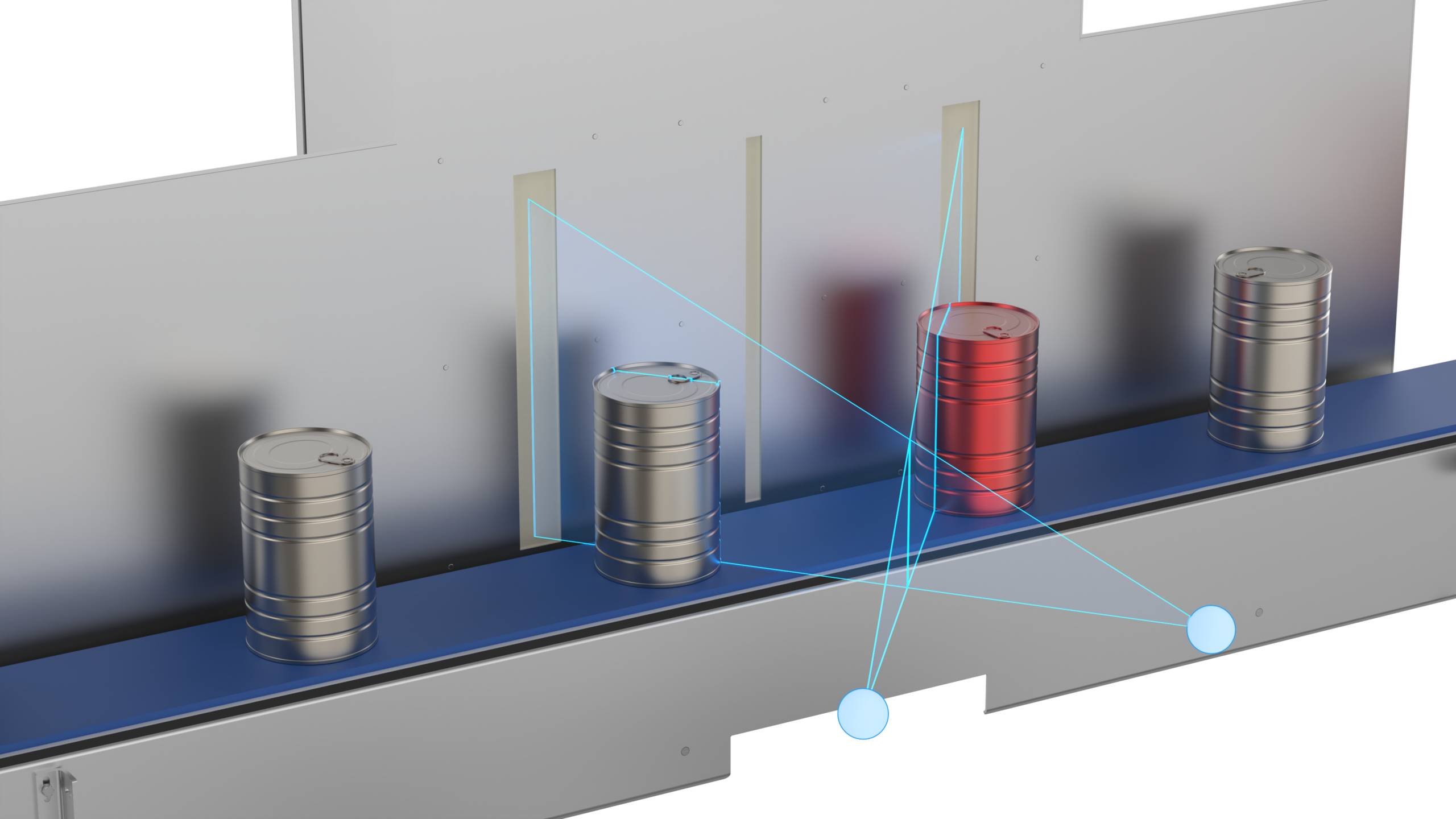
In the case of tins or bags, a vertical shot is usually used.

Vertical spraying has two different settings: bottom-up and top-down. Bottom-up spraying is recommended when there is a chance that contaminants may have settled in the upper part of the container, just below the lid. In contrast, top-down spraying is better suited to removing contaminants that tend to settle at the bottom of the can.
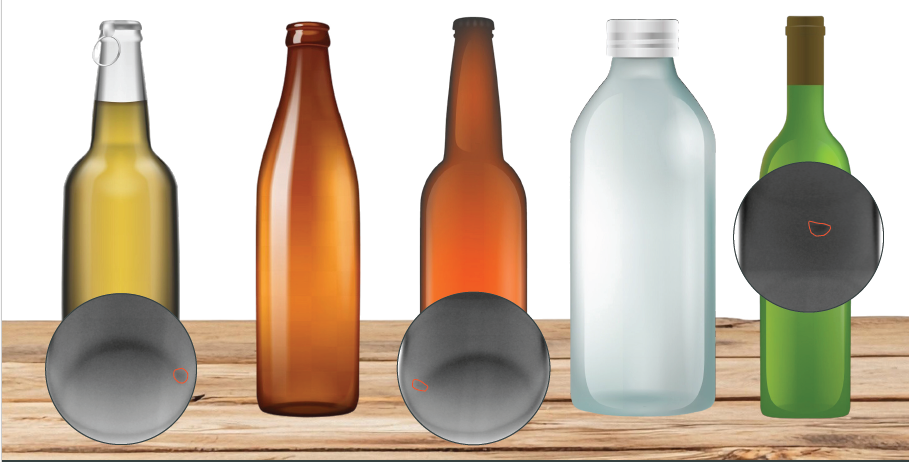
If glass jars are to be inspected, the system should feature a dual-angle scanning configuration, utilising two generators with different angles of approach. This allows for greater versatility when inspecting the product and enhances detection capabilities. In some cases, a triple-angle scanning configuration may even be required.
The dual side spray also has two settings. The bottom-to-top spray is particularly suitable for jars containing dense contents such as preserves, whilst the top-to-bottom spray is used on jars containing liquids or similar items.

When you need to inspect both glass jars and tins on the same production line, it is best to install equipment featuring a dual vertical side-view scanner, which will provide the flexibility required to analyse these different types of product.
What if the pollutant is glass as well?
Preserving jars are generally made of glass, and so in many cases the contaminant may be the glass itself. This type of material is highly permeable to X-rays; in other words, it absorbs very little energy due to its low density. If a product is contaminated with glass, it can be very difficult to detect, depending on where the glass has lodged within the product.

In most cases, the glass forms the walls of the jar itself, so it is flat. If the X-rays pass through the thinnest part, they will be harder to detect. The solution is to use a second X-ray beam that passes diagonally through the glass, making it detectable.
Solution for detecting fish bones
X-ray inspection equipment meets most of the canning industry’s needs for reliable contaminant detection. However, the process of detecting any fish bones remaining in the fish after they have been removed is more complicated. During the handling and sterilisation process, these bones undergo a decalcification process that alters their density, making them difficult to detect during X-ray inspection. Consequently, the sensitivity of the equipment needs to be increased. This is achieved by improving image resolution using HD cameras integrated into the equipment and high-definition generators.
These images are analysed by advanced image-processing software developed by Varpe, which offers maximum accuracy in the detection of foreign objects, as shown in the example image.

Furthermore, if the level of difficulty requires it, a Varpe artificial intelligence system can be included.
Equipment that can be easily adapted to the production line
Side panels
The equipment can be easily integrated into the existing production line. The system is designed to ensure a smooth transfer of the product from the customer’s conveyor belt to the X-ray or checkweigher equipment via a system of side belts that guarantees accurate delivery.

There are also other options available depending on the customer’s requirements, such as magnetic feeders or screw conveyors with intelligent control.
Penalty area
The machine features a rejection zone for contaminated products. These rejected containers are diverted from the conveyor belt and transported to the non-conformance zone via, for example, a roller system.

Equipment with a hygienic design
A hygiene-focused approach to the design, construction, installation and use of X-ray inspection equipment and checkweighers involved in the processing of unpackaged or semi-packaged food is one of the most effective preventive measures for ensuring the safety of manufactured products and minimising the risk of production line issues arising, for example, from the accumulation of product residues.
For this reason, VARPE manufactures equipment specifically designed for the canning industry, based on EHEDG guidelines. In such equipment, the product flowing through the machine often tends to settle on key components, which can sometimes hinder the system’s proper functioning. Thanks to its hygienic design, this problem is avoided.
What are the benefits of this sanitary equipment?
- They are easy to clean, and features such as buttons, valves or screens are avoided in the area that comes into contact with the product.
- By preventing waste from building up on the various parts of the machine, fewer stoppages are required for cleaning during production.
- Thanks to its hygienic design, less residue builds up that could cause problems.
How can the build-up of debris be resolved?
Sloping surfaces
Replacing horizontal surfaces with sloped ones to prevent waste from accumulating in the machine and affecting its proper functioning.
Micro-adjustment stops
The equipment periodically performs micro-stops lasting a few thousandths of a second which, without affecting production, are used, for example, to perform zero adjustments.
No dead spaces
Dead spaces are avoided as far as technically possible, and where they do exist, their drainage, cleaning and disinfection are facilitated.
IP69K
Equipment with the highest protection and waterproofing ratings, designed to withstand high-pressure washing and steam cleaning.
Advanced software
The system issues warnings if the equipment has not performed functions such as a no-load test for too long, in order to prevent production faults.
Special settings for weight control
- By accumulating less residue, we prevent the zero weight from being compromised.
- By positioning the checkweigher at the top of the machine, the build-up of product residue that affects the weight is prevented.
- Using hanging castors prevents the need to place other items underneath, which tend to collect debris and can distort the weight reading.
Special adjustments for X-ray equipment
- Where a hygienic design is in place, X-ray inspection equipment does not require lead shielding, although it continues to comply with safety standards for ionising radiation and remains exempt.
Weighing for high-volume production
The V2000 Can high-throughput checkweigher is the ultimate solution for high-speed requirements in extremely harsh environments. These weighing systems deliver high levels of performance, particularly when weighing tins (canned goods). They feature advanced weighing electronics, maximum accuracy, state-of-the-art software and a hygienic design to meet market demands for cleanliness and accessibility.
Its modular system provides flexibility and facilitates the installation and start-up of the equipment. The V2000 Can is equipped with the latest technological advances: touch screen, extensive communication systems, and versatility.
The system incorporates features such as static and dynamic product calibration, product self-learning to optimise production, auto-zero or auto-track for automatic weight adjustment, and an audit trail of settings and configurations; it also provides full control over all processed items. All of this is managed via an intuitive and user-friendly human-machine interface.

It also features equipment functionality checks, advanced user management and three-tier password-protected access, as well as data integrity security.
It allows you to view, export and analyse rejections and features a conveyor belt or slide and side guides, a separate workbench and an anti-vibration reinforcement base