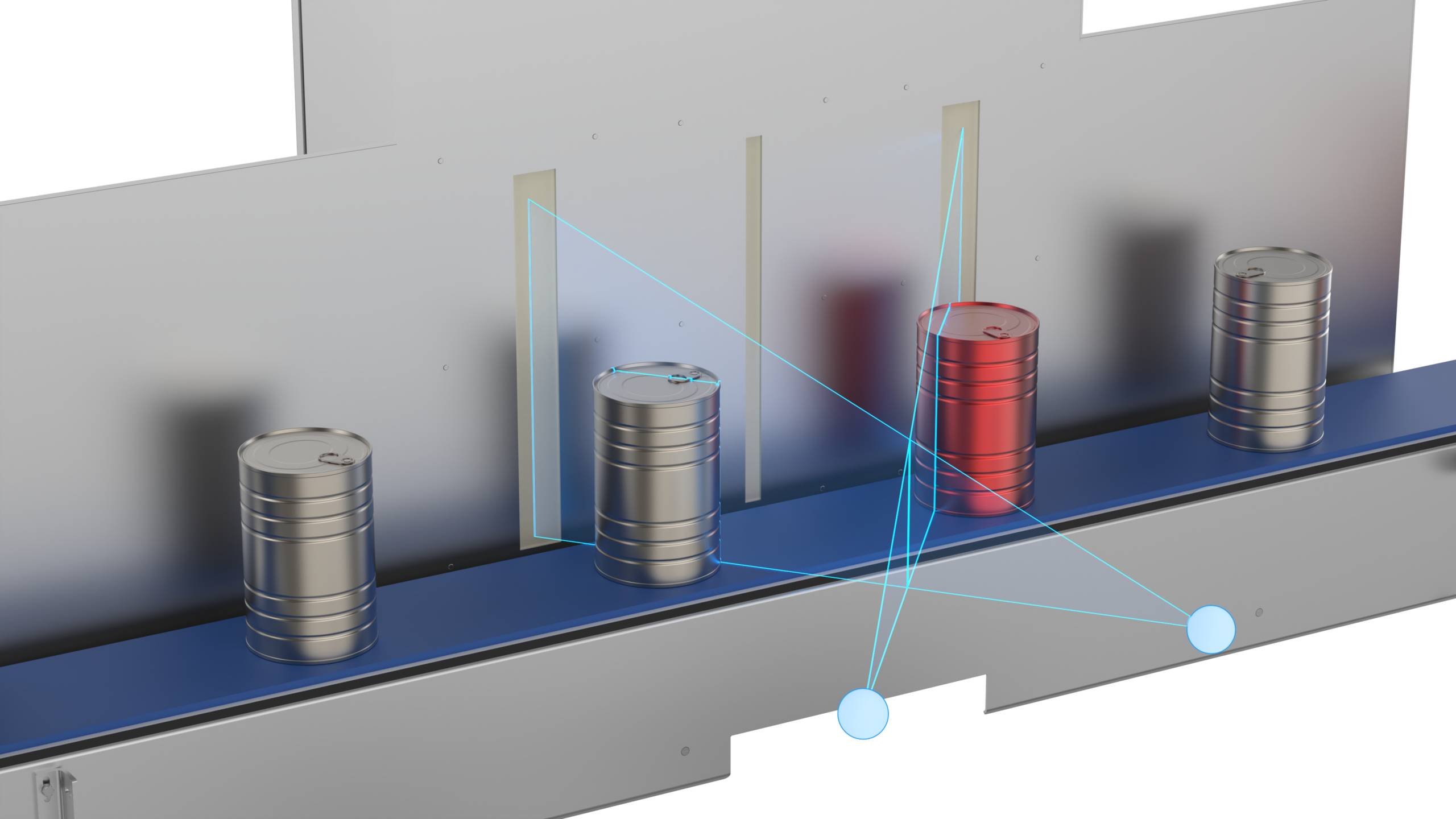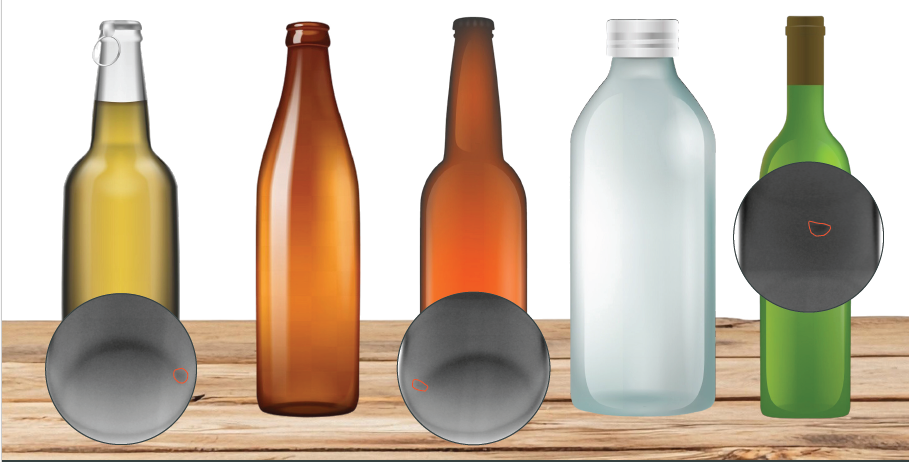
A renowned European beverage manufacturer identified a critical issue in its production line: the presence of glass fragments inside its glass bottles. The source was traced to microfractures generated during the filling and transport of the containers, as well as to accumulated wear in the return lines of reusable packaging.
The risk was not only sanitary. Each batch with potential contamination jeopardized distribution contracts with major retail chains, exposed the company to RAPEX alerts, and threatened the continuity of IFS Food and BRC certifications—essential for its key European retail customers.
The quality management team needed a solution capable of inspecting 100% of production in-line, without interrupting the bottling pace, and with sufficient reliability to withstand customer audits.
Why it is one of the most demanding inspections in the food industry
Detecting glass within a glass container represents one of the greatest technical challenges in industrial X-ray inspection systems. The reason is physical: the contaminant material and the container share similar density, radiation absorption coefficients, and optical transparency.
The three technical challenges shaping the system design
- Radiological density similarity. Conventional X-ray detectors identify foreign bodies based on differences in attenuation. When the contaminant is made of the same material as the container, the signal contrast is drastically reduced, increasing the risk of false negatives.
- Critical overlap zones. Fragments that settle at the base or along the inner walls of the container become masked by the mass of the glass itself. The signal from the contaminant overlaps with that of the container, making inspection with standard single-channel technology unfeasible.
- Morphological variability of the fragment. Glass splinters do not have a regular shape. They can appear as thin flakes, irregular edges, or spherical fragments, requiring the detection algorithm to be robust against variations in shape, orientation, and size, including fragments with very low mass.
Regulation (EC) No 852/2004 on the hygiene of foodstuffs and the requirements of HACCP systems mandate the identification and control of all relevant physical hazards in the production line. Glass is classified as a critical hazard in EFSA guidelines and in the IFS Food version 8 standard (requirement 4.12) and the BRC Global Standard for Food Safety (clause 4.9).
The Varpe solution: X-ray inspection systems with machine vision and artificial intelligence
After a thorough analysis of the production line, the type of packaging, process speeds, and the history of non-conformities, Varpe’s technical team designed a tailored combined solution for detecting glass in glass containers, internally named Glass in Glass.
Technical components of the installed solution
High-resolution machine vision
Inspection cameras with controlled lighting to complement the signal in areas with low differentiation.
Integration with VIT4 software
Real-time transfer of inspection data to the VIT4 software for batch-by-batch traceability and automatic reporting for audits.
AI algorithms for Glass in Glass detection
A neural network specifically trained on glass fragments in different positions and morphologies within glass containers.
Seamless integration without stopping the line
The system was installed in-line without the need to modify the plant architecture. The automatic rejection module removes non-compliant containers, leaving the production flow unaffected. The inspection speed is compatible with rates of up to 800 units per minute.
The system parametrization was carried out using real glass samples provided by the customer, allowing detection thresholds to be fine-tuned, minimizing false positives without sacrificing sensitivity. This balance is critical for operational viability: an excess of unnecessary rejects leads to product losses and discourages operators from adhering to the equipment parameters.
Regulatory compliance and continuous traceability
The implementation of this X-ray inspection system not only solved the detection problem: it enabled the client to document control of the physical hazard “glass” in their HACCP plan with objective, auditable evidence.
What integration with VIT4 brings to the quality manager
Varpe’s VIT4 software records each individual inspection with a timestamp, batch number, inspection result, and rejection code. This data is automatically exported in formats compatible with the client’s MES and ERP systems, eliminating the need for manual data entry.
During the IFS Food and BRC audits following installation, the client was able to present auditors with comprehensive traceability reports, including equipment performance statistics (uptime, number of rejects, frequency of self-checks) extracted directly from the system.
For further details on the regulatory requirements applicable to foreign body detection in the beverage industry, refer to the IFS Food Standard version 8 technical guideline (section 4.12) and the BRC Global Standard for Food Safety (Issue 9, clause 4.9).
Conclusion: specialized technology makes the difference
Detecting glass in glass containers does not allow for generic solutions. The physical similarity between the contaminant and the container requires an inspection architecture specifically designed for this scenario, with the capability to simultaneously process radiological and optical signals, and algorithms trained on real product data.
Varpe’s Glass in Glass solution combines multi-angle X-ray inspection systems with high-resolution machine vision and artificial intelligence, integrated into the VIT4 software to ensure full traceability. The result is a system that the quality manager can confidently defend in any audit, and that the operations director can sustain without compromising line efficiency.
Varpe is a Spanish manufacturer with an ENAC-accredited laboratory, its own after-sales service, and ISO 9001 and ISO 14001 certifications. The engineering team carries out a prior analysis of each installation, defining detection parameters based on real samples provided by the customer.
Does your line inspect 100% of glass containers?
Discover how Varpe can help your plant reliably detect glass fragments with audit-proven performance.
We analyze your case with no obligation.
other blogs